Change Language :
Universal for food contact, without PTFE

iglidur A181PF
The PTFE-free alternative to the proven food contact standard iglidur A181 offers the same performance at almost the same price.

Tech up
100% comparable with or better running performance than iglidur A181 - without PTFE

Cost down
Price only 10% higher compared to iglidur A181

Proof
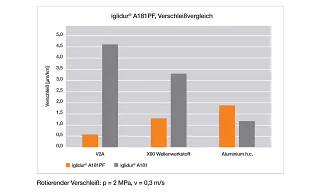
Tested in the igus tribo laboratory (rotating wear: 0.3m/s, 2MPa, 304 stainless steel; A181PF: 0.57μm/km, A181: 4.6μm/km)

Sustainability
- Lubrication-free dry operation means that no lubrication is released into the environment
- Sustainable due to the absence of PTFE or perpetual chemicals
- Find out more about sustainability at igus
From the development department, interview with Dr Magnus Orth, Head of the igus Material Centre
New PTFE-free plain bearing material for food contact

Dr Orth, how do you assess the current status of PFAS regulation?
"The European Chemicals Agency (ECHA) continues to work on the evaluation of the PFAS restriction proposal. The final scientific opinions of the responsible committees are expected in 2026. A decision by the European Commission is therefore not due until 2027 at the earliest. In 2025, the original proposal has already been expanded and supplemented with additional areas of application, which shows that the regulatory debate has broadened." [cirs-ck.com] [echa. europa.eu]
Why did igus decide to develop a PTFE-free material - especially for food contact?
"Our customers in the food technology sector need materials that are safe in the long term in regulatory terms. PTFE belongs to the PFAS family and is therefore automatically at the centre of the current debate. Regardless of what the final rules look like, we want to offer our customers solutions that are not affected by possible future restrictions. Food contact materials are subject to particularly strict cleanliness and hygiene standards. A PTFE-free material provides a clear and reliable starting point right from the start."
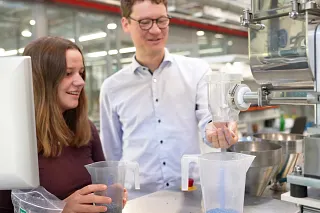
Dr Magnus Orth and material developer, Lena Arnold, in the igus test laboratory
What were the technical challenges in developing a PTFE-free plain bearing material?
"PTFE traditionally fulfils an important function when it comes to low coefficient of friction and good dry-operating properties. Developing an alternative that works without PTFE meant completely realigning the tribological specifications. For food contact applications, there are additional requirements: resistance to cleaning and media, low migration, strong mechanical specifications. We tested many material combinations until we found a solution that reliably fulfils all these points. The new material is therefore based on a combination of alternative solid lubricants and an optimised polymer matrix, which together result in a robust, food-grade overall profile."
What advantages does the new material offer users in the food industry?
"First of all, it offers planning security - especially in view of the ongoing PFAS regulation. Customers can be sure that the material will remain fully usable regardless of the future design. In technical terms, it impresses by its good dry operating properties, high wear resistance and resistance to cleaning and disinfection processes. This makes it suitable for typical applications in food production where reliability, hygiene and short maintenance intervals are important."
What does the future development of igus look like?
"The new material is an important step, but not the last. We are already developing other PTFE-free materials for applications with higher loads, higher temperatures or abrasive media. The aim is to offer our customers a broad portfolio of modern, PFAS-free plain bearing materials that are compliant in the long term both technically and in regulatory terms."
More information on PTFE-free and PFAS-tested bearing technology products from igus
In view of the current discussion about a ban on PTFE or PFAS, we have put together all the important information about our plain bearings here. In addition, you will find a list of all iglidur materials that do not contain PTFE or that have been tested for PFAS that are considered critical or harmful to health.


Consulting
I look forward to answering your questions
igus® (Pty) Ltd. +27 11 312 1848Write e-mail
Shipping and consultation
In person:
Monday to Friday from 7 am - 8 pm.
Saturdays from 8 am- 12 pm.
Online:
24h
WhatsApp-Service:
Montag – Freitag: 8 – 16 Uhr