Change Language :
REACH
The European regulation for chemical substances
REACH stands for Registration, Evaluation, Authorisation, and Restriction of Chemicals. REACH is a European Union regulation (EC 1907/2006) that came into force on 1/6/2007.
In 2007, the regulation harmonised and simplified the chemicals legislation in force to that point. It also replaced various decrees. The goal of REACH is to better protect human health and the environment. The REACH regulation therefore regulates the use of chemical substances that are used in industrial processes and products as well as in everyday products, e.g. clothing, furniture and electrical appliances. The regulations state that manufacturers, importers and downstream users are responsible for the chemicals used. It must be ensured that the manufactured chemicals that are placed on the market are used safely. The scope includes manufacturers and/or importers who manufacture more than one tonne of substances per year in the European Union or import this quantity into the European Union. The REACH regulation is considered to be modern but also one of the strictest chemical laws in the world.
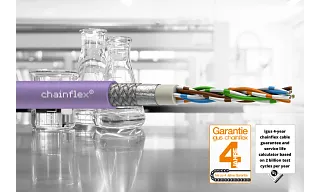
This means the following for our chainflex cables:
The REACH regulation only applies to igus® to a limited extent: As a manufacturer of cables, the company is defined as a so-called "downstream user" with regard to the value chain. Nevertheless, the contents of the REACH directive and its rules for the production and processing of chemical substances are observed at igus®. For example, no chemicals are used in the production of chainflex® cables that are above the applicable REACH limits. The entire range of chainflex® cables is free from materials such as sodium peroxometaborates, cadmium sulphides or dihexyl phthalates.
Information according to REACH Regulation (EC) No. 1907/2006 - communication of information on substances in products (Article 33):
chainflex cables with a flame-retardant TPE outer jacket contain decabromodiphenylethane.
"The product contains decabromodiphenylethane in a concentration of more than 0.1% (CAS-No. 84852-53-9), a substance of very high concern (SVHC) included in the REACH Candidate List."
What does this mean for the utilisation of these cables?
The use of flame-retardant TPE cables is still permitted. Inclusion in the list of candidates does not constitute a prohibition, but only an obligation to provide this information.
Any questions?
Do you have questions about this topic, about the cables you use or do you have uncertainties that you would like to clarify?
Feel free to contact us at any time! Our experts will be happy to help you.

Take a look at the complete REACH regulation here
Download it now!Alternative cables without halogen
Do you want to rely on halogen-free cables and still use a high-end outer jacket? No problem, there is a wide range of cables with halogen-free TPE material. We have an alternative in TPE halogen-free suitable for every TPE flame-retardant cable:
| TPE flame-retardant cables | UL AWM | DBDPE | Bend radius in the e-chain | TPE halogen-free alternative | UL AWM | DBDPE free | Bend radius in e-chain |
|---|---|---|---|---|---|---|---|
| CF9.UL | √ | √ | 5 x d | CF9 | √ | √ | 5 x d |
| CF10.UL | √ | √ | 5 x d | CF10 | √ | √ | 5 x d |
| CFBUS | √ | √ | 10 x d | CFBUS.LB | √ | √ | 7.5 x d |
| CF34.UL.D | √ | √ | 7.5 x d | CF37.D | √ | √ | 7.5 x d |
| CF35.UL | √ | √ | 7.5 x d | CF38 | √ | √ | 7.5 x d |
| CF300.UL.D | √ | √ | 7.5 x d | CF330.D | √ | √ | 7.5 x d |
| CF310.UL | √ | √ | 7.5 x d | CF340 | √ | √ | 7.5 x d |
| CFPE | √ | √ | 7.5 x d | CFPE.ZH | √ | √ | 7.5 x d |
Consulting
I look forward to answering your questions
igus® (Pty) Ltd. +27 11 312 1848Write e-mail
Shipping and consultation
In person:
Monday to Friday from 7 am - 8 pm.
Saturdays from 8 am- 12 pm.
Online:
24h
WhatsApp-Service:
Montag – Freitag: 8 – 16 Uhr